A Maryknoll priest leads a restorative retreat for those who minister to the Church in Myanmar amid war and privation.
In April, I traveled to Myanmar — a Level 4 destination for U.S. passport holders, meaning the United States Department of State strongly advises against travel there. Despite the risks, I felt compelled to go.
I had been invited by Archbishop Marco Tin Win of Mandalay to lead a Zen contemplative retreat. Archbishop Tin Win was originally appointed by Pope Francis and later reappointed by Pope Leo XIV to the Vatican’s Dicastery for Interreligious Dialogue. He has a personal interest in contemplative practices, and through quiet connections in the Zen community, he learned of my work and graciously extended the invitation.
I traveled to Myanmar from Bangkok with fellow Maryknoll missioner Father John Barth, who is based in Thailand. He works closely with Myanmar refugees, many of whom have been displaced by the military junta. Entire villages have been bombed, forcing families to flee and seek safety wherever they can. After a long period of demanding service in refugee camps — providing food, care and accompaniment — Father Barth felt the need for renewal and joined the retreat.
We arrived at Mandalay International Airport, where Father Augustine Win Myint, the archdiocesan finance minister, warmly welcomed us. From the start, we were welcomed by all with genuine kindness. Father Win Myint was already familiar with Father Barth through the ongoing work of the Maryknoll Fathers and Brothers in the region. He now serves as a local coordinator of Father Barth’s initiatives, overseeing the distribution of funds sent by benefactors in the United States.
On the way to the seminary, the place where the retreat was held, Father Win Myint showed us several rebuilding efforts supported by Maryknoll after last year’s devastating earthquakes. Even now, aftershocks continue to cause damage and uncertainty. We also visited programs that provide education for young people and food for children. The impact of this support is deeply felt. Many people — especially the elderly and the young — expressed heartfelt gratitude for Maryknoll and its benefactors. Increasingly, alongside this material assistance, there is also a deepening hunger for spiritual support.
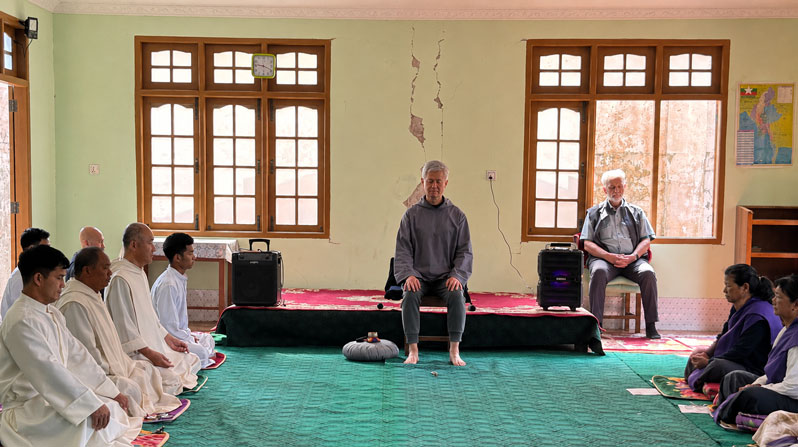
Maryknoll Father Alfonso Kim, center, leads a weeklong contemplative retreat at the request of the Archdiocese of Mandalay, Myanmar. Shown beside him is Maryknoll Father John Barth, who supports relief efforts in Myanmar and in Burmese refugee camps in neighboring Thailand. (Courtesy of Alfonso Kim/Myanmar)
We spent our first night at a guesthouse, then moved to the seminary, where we would spend a week in prayer and silence. Together, Archbishop Tin Win and I prayerfully arranged the schedule. The itinerary was demanding — especially for those new to the practice — but many participants had been meditating for years. Each day involved long periods of stillness: three one-hour meditations, several shorter sittings, and gentle walking meditations woven in between, allowing both body and spirit to remain attentive.
My hope throughout the retreat was simple yet deeply meaningful: to accompany each person as they entered more purposefully into their own heart, where God already dwells.
The 150 participants included the bishop, priests, brothers, sisters, seminarians and lay church workers, as well as some non-Catholics. Archbishop Tin Win had asked me to help guide them in facing their pain and struggles, not to avoid them, but to encounter them honestly, so that true reconciliation might begin. In a country bearing both visible and invisible wounds, this inner work felt especially urgent. In this context, contemplation is a path to healing.
Again and again, I invited the participants into stillness — to sit without moving, to breathe naturally, and to allow God to act within them. We often think we are the ones praying, but in truth, God prays within us. God stirs the heart, brings reconciliation and gently leads us back to wholeness. Our part is to consent, be present and let go.
We spent many hours together in silence, each person quietly entering their own inner struggle. For some, like Father Barth, it was their first Zen retreat. It was moving to witness how deeply the experience touched them. In that silence, there were moments of grace — times when people began to see themselves more truthfully and perhaps more compassionately.
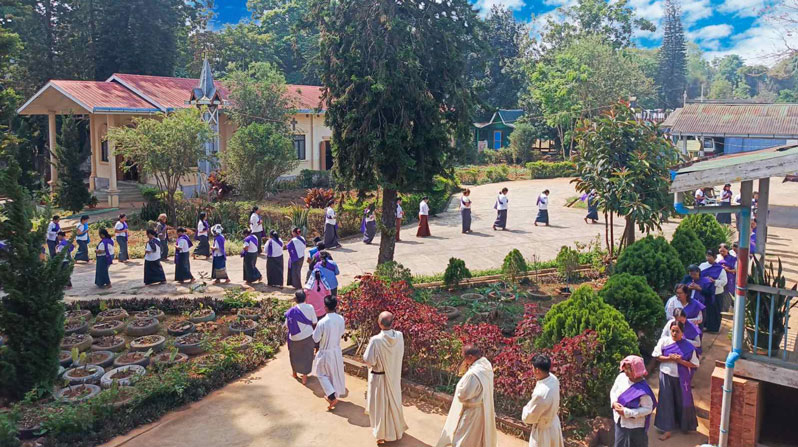
The retreat, based on Zen practice and held April 11-18 for 150 participants, included a walking meditation and other techniques to foster contemplation. (Courtesy of Alfonso Kim/Myanmar)
This retreat was only a beginning, a first step toward reconciliation with the wounds we carry. Yet even in this brief time, after many hours of sitting and waiting in stillness, some began to taste a deepening inner peace, a quiet that does not come from us but from God.
The seminary, surrounded by Buddhist temples, a Hindu ashram and a mosque, echoed each morning with calls to prayer — reminding us of God’s presence across traditions.
And still the journey continues. We are invited to return to this silence again and again — to sit, to pray and to remain open. There is no fixed measure for goals in this, only the gentle call to remain with God as long as we are able, trusting that God is already at work within us.
At the end of the retreat, we parted ways and returned to our respective lives, carrying those lives forward with joy in God and a sense of grace, a grace that helps us learn to reconcile with one another and live in peace. I encouraged all the participants to continue silent meditation amid their challenging lives, where God is present and constantly speaks to us in the languages of silence and love.
Featured image: Shown left to right are Benedictine Father Jonas Lee, Maryknoll Father Alfonso Kim, Archbishop Marco Win Tin and Maryknoll Father John Barth. In addition to carrying out the contemplative retreat, the clergy reviewed earthquake relief efforts led by the Archdiocese of Mandalay coordinated by Father Augustine Win Myint and supported by the Maryknoll Society. (Courtesy of Alfonso Kim/Myanmar)