A Maryknoll seminarian reflects on his vocation journey as he prepares for his upcoming ordination.
Victor Mutobera’s earliest childhood memories include pretending to celebrate Mass. “I used to gather with my friends and my twin brother, and we would assign roles,” recalls the Maryknoll seminarian. “Some formed a choir, others acted as lectors, and I played the priest.”
The children salvaged an old car tire, which young Victor would roll along the road, saying he was on his way to a village to say Mass. The transitional deacon, who will be ordained to the priesthood on June 6, was born into a devout Catholic family in Kakamega, Kenya. His parents baptized him as an infant and raised him alongside nine siblings.
Becoming an altar server at his parish, Mutobera often traveled with priests to outstation chapels. It was a joyful experience, he says. He remembers people telling him, “You’re going to be a good priest.”
He attended a diocesan minor seminary, equivalent to high school, while considering entering the major seminary. Mutobera’s parents advised him, “Earn a degree first. If God still calls you afterward, you can join the seminary.”
While studying at Kenyatta University in Nairobi, the capital, Mutobera met Father Lance Nadeau, then a chaplain and now the superior general of the Maryknoll Society. “What inspired me most was how he preached the Gospel both through words and his way of life. He was a great example to me,” Mutobera says. “His homilies were so powerful and moving that the chapel couldn’t accommodate everyone, so we set up tents outside.”
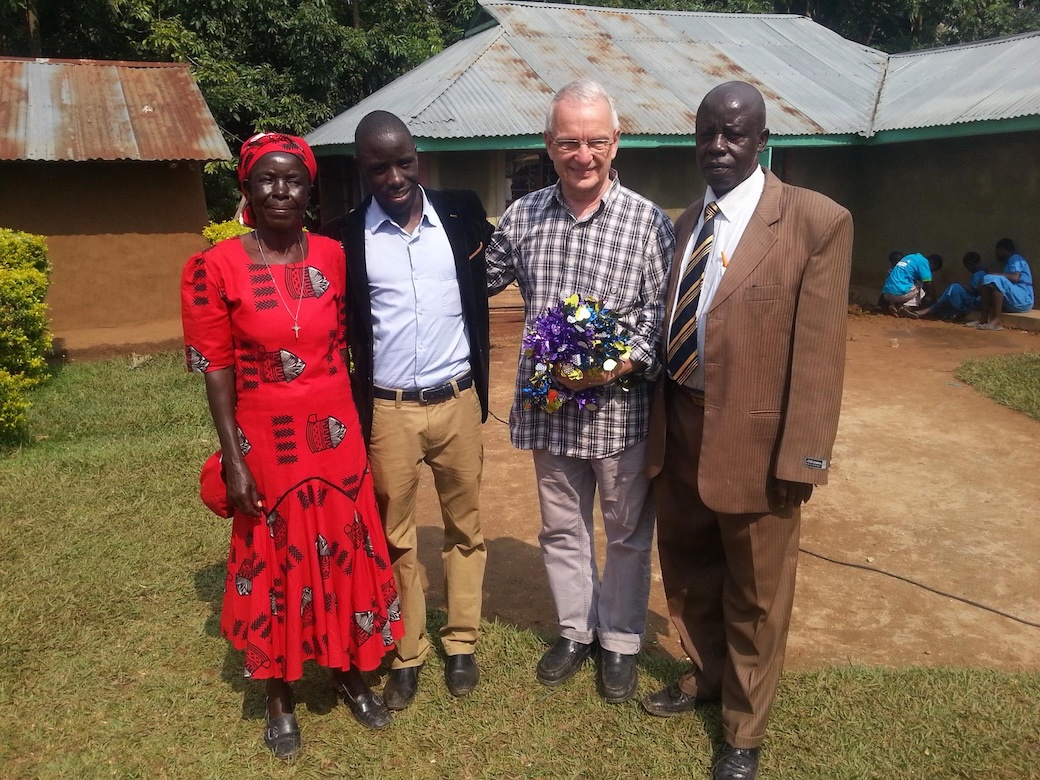
Maryknoll Father Lance Nadeau, then a university chaplain for Kenyatta University students, meets young Victor Mutobera’s parents Roselyn Barasa and Timothy Mutobera in 2019. (Courtesy of Victor Mutobera/Kenya)
The priest’s sermons, he adds, “made me reflect deeply on my vocation.”
Mutobera completed a bachelor’s degree in economics and statistics. During his college breaks, he visited Maryknoll missions in Tanzania. He also traveled to Turkana, in northern Kenya, where Father Nadeau supported a mission helping fishermen improve their skills and enhance their livelihoods.
That was the turning point for Mutobera. Father Nadeau dedicated his life to people, he says. “This is what I want to live for.” He joined the Maryknoll Fathers and Brothers in 2018.
After studying philosophy at Tangaza University in Nairobi, in 2019 Mutobera traveled to Chicago to begin his year of spirituality with the mission society.
Attending church for the first time in the United States felt quite different, he recalls, because he was accustomed to services where people sang, danced and clapped. “Here was the solemn Mass, with only one person singing in the choir, and the rest of the congregation listening,” he says. “Over time, I began to recognize how meaningful and beautiful the Mass and its music were.”
Maryknoll’s formation for priests and brothers includes two years in mission in the Society’s Overseas Training Program. Mutobera was assigned to Bolivia, where he appreciated the strong sense of community and family-oriented culture. He stayed with a host family. “I found joy in being with them, even though I didn’t yet understand Spanish,” he says. “Just being there and listening helped me build a relationship with the family.”
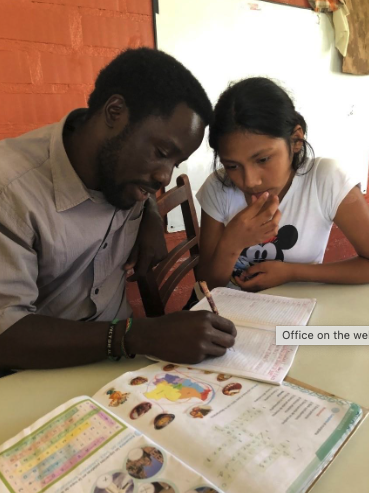
As part of his overseas training, Mutobera tutors at-risk students at the Cristo Rey home for youth in Cochabamba, Bolivia. During their vocational discernment, Maryknoll seminarians and brother candidates serve in various ministries in cross-cultural contexts. (Courtesy of Victor Mutobera/Bolivia)
“We value his humility, spiritual values, and his vocation for helping those in greatest need,” says René Arze, Mutobera’s host father. The family was inspired to volunteer at the seminarian’s ministries.
“It was truly inspiring to see the affection and respect he earned from the children and young people he assisted,” Arze continues. “I feel deeply honored when he calls me ‘Dad.’”
Mutobera’s service at Cristo Rey, an orphanage run by the Augustinians for children and teenagers who have experienced violence, involved caring for those who had been either removed from or abandoned by their families.
“I helped young kids with reading and taught values that are essential for a good Christian life. A lay Franciscan missioner and I talked to the teenagers about hope, the importance of trust, friendship, and the role of God’s love,” the seminarian says. “There were kids interested in learning music. I taught them to play the guitar.”
He adds, “Cristo Rey provided a very good environment for the children to experience the love and the family they might not have had.”
In addition to his ministry at Cristo Rey, the seminarian joined pastoral visits to two prisons in Cochabamba. There, missioners led worship services and offered holy Communion to inmates.
During his Overseas Training Program, Mutobera also assisted in Maryknoll’s mission to the Amazon. At a rural parish in the Isiboro Sécure National Park and Indigenous Territory (TIPNIS), he taught catechism classes, brought Communion to the sick and accompanied priests to remote communities to celebrate Mass.
Three years ago, the seminarian returned to Chicago to continue his theological studies at Catholic Theological Union. While completing his Master of Divinity, he served in ministry at Mother of the Americas parish in the Little Village community. The Spanish he had learned in Bolivia helped him serve Hispanic parishioners.
At Mother of the Americas parish, Mutobera provided catechism classes for youth, oversaw altar servers and volunteered in migrant ministry. “The ministry is about being just, good neighbors, brothers and sisters, and sharing God’s love with those who need it most,” he says.
Every Saturday, the parish opens its food pantry, offering food and clothing to about 350 people. Maribel Lenus, director of the migrant ministry, says that their goal is to support the community, especially parishioners living in the shadows. Some have stopped working, she says. Children from families without citizenship or permanent residency are afraid to attend school, feeling anxious that their parents might be detained by U.S. Immigration and Customs Enforcement (ICE). The ministry includes informing migrants about their rights.
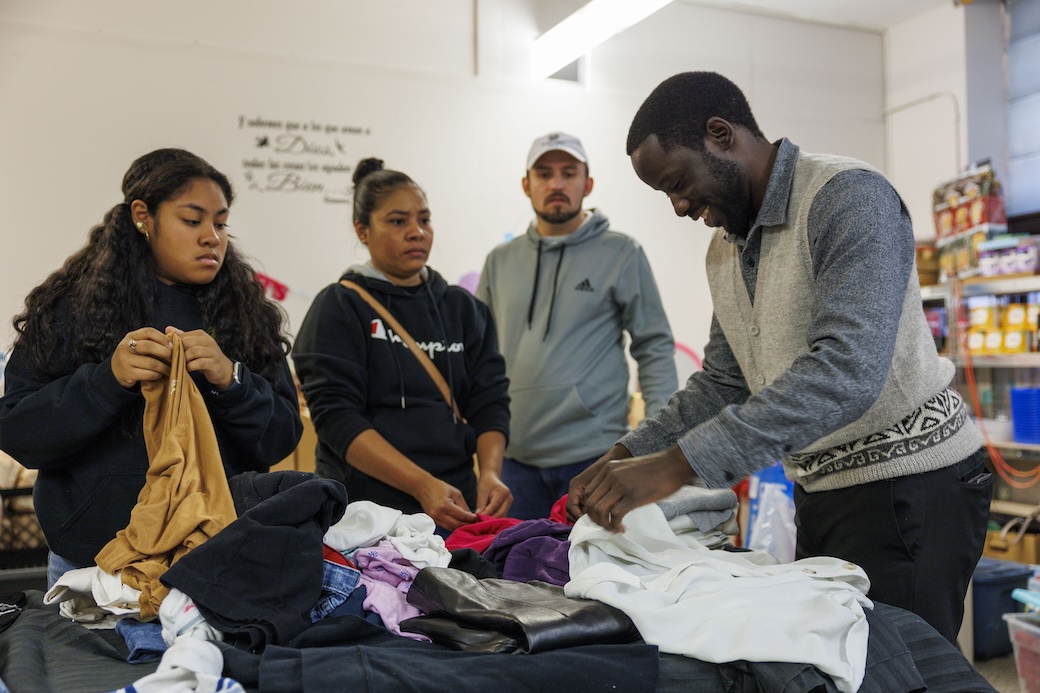
While in Chicago earning his divinity degree at Catholic Theological Union, Mutobera serves with other volunteers in migrant ministry at Mother of the Americas parish. (Courtesy of Victor Mutobera/U.S.)
Lenus is grateful for Mutobera’s compassion toward others, she says. “Mission involves building connections with others who may differ from us,” Mutobera says, “but we are united by God’s love.” God’s grace, he continues, has been evident throughout his vocational journey. “I discovered love, joy and Christ in those I encountered.”
Mutobera says he has learned valuable lessons from fellow seminarians and missioners, notably the formation rector, Maryknoll Father Brian Barrons: “He emphasized the importance of community involvement and teamwork.”
Father Barrons, who visited the seminarian’s hometown last summer, says there he was able to see how Mutobera’s faith and vocation were shaped within his family.
“Victor’s love for God and God’s people will serve him well in mission,” he says. “You feel his warmth in the things he does, the words he uses to welcome and encourage others, and most especially in his very Christlike lifestyle. He is a true missionary disciple.”
After eight years of formation, Mutobera, 36, looks forward to his ordination. “I am deeply grateful,” he says. “I pray that the good Lord will continue to lead me.”
Featured image: Maryknoll Seminarian Victor Mutobera, 36, shown at the Maryknoll Society formation house in Chicago, will be ordained a priest on June 6 after eight years of intensive preparation. Mutobera, who is from Kenya, became a transitional deacon last year as a step toward the priesthood. (Octavio Durán/U.S.)