A Maryknoll missionary disciple reflects on his story of migration and service.
One day while I was studying law at the University of San Carlos in my native Guatemala, there was an evacuation order during final exams due to a bomb threat. Everyone left the building in dismay. Days later, 10 student leaders were kidnapped. Five were murdered and the others reported missing, never to be seen again. These events, which took place in August and September of 1989, were added to a growing list of kidnappings and murders of university students.
The students were among the 200,000 casualties of Guatemala’s 36-year civil war. From 1960 to 1996, governmental armed forces clashed with guerrilla groups, resulting in serious human rights violations.
The government blamed subversive forces for the student killings. Later, international reports indicated that many students were victims of military operations.
During this time, the situation in Guatemala City intensified even more. The government declared a curfew; no one was allowed to go out after 6 p.m. University classes were canceled, and public gatherings were banned. At night, soldiers patrolled the streets. If they found someone, they could arrest them and force them to join the army. Subversive groups also pressured young people to join their cause.
In rural areas of the country, where the conflicts first began, the violence became unbearable. Many Indigenous communities were trapped. Severe human rights violations, torture and murders occurred, and entire village communities were razed.
I found myself at a dead end, despite having been born in “the land of eternal spring.” Protected by a chain of impressive volcanoes, with dense jungles and beautiful lakes and rivers that paint the landscape, Guatemala is teeming with life. Recognized among the world’s 20 most diverse countries, it is home to a large part of the planet’s biodiversity. In this multicultural nation, 22 languages are spoken including Mayan, Garifuna and Xinca.

I had a wonderful childhood in Guatemala City with my parents and two sisters. There were many role models for service within my family. My grandmother Gabina was active in the parish, accompanying families as a community prayer leader when they lost a loved one. Growing up, I wanted to become a professional soccer player. I also considered a career in law. I was fortunate that my parents sent me to study at a prestigious university in the capital.
However, amid the violence, my dreams were dashed. The only option I had was to leave Guatemala. I understand now why people speak of “forced migration” when someone doesn’t want to leave their home but feels there’s no choice.
I embarked on a 20-day journey to reach the United States. I remember walking all night through the mountains to the border in San Diego, California. Thank God I arrived safe and sound.
Adapting to the United States was a whole other challenge, as I didn’t speak English and wasn’t familiar with the lifestyle. I had to work hard to make a living. I recall my first job, as a gardener. It was a sweltering summer, and I had no prior experience. I would come home exhausted and wake up with muscle pain. But I had to support myself and also send money back home to my parents in Guatemala, as the situation there wasn’t improving.
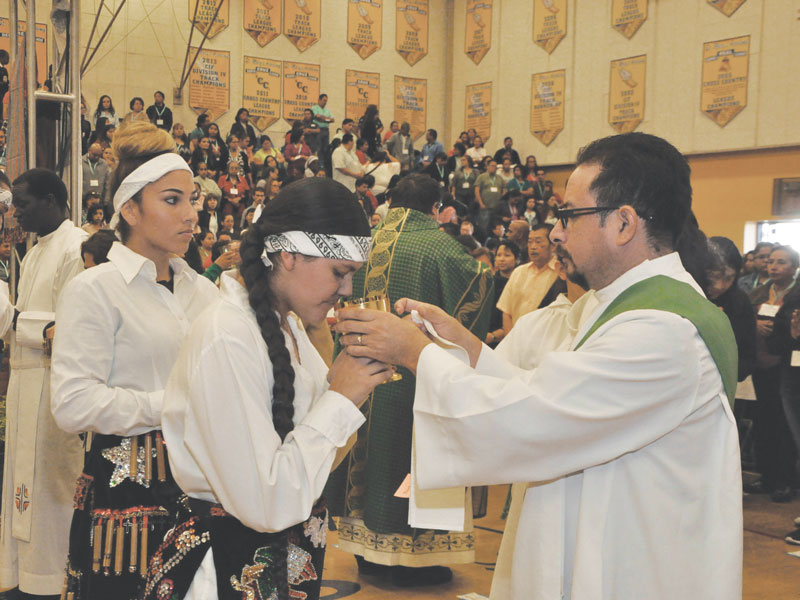
Deacon Leonel Yoque distributes Communion to participants who attended Our Lady of the Angels Congress in 2017. The regional religious education congress, organized by the Archdiocese of Los Angeles, was held at St. Mary’s Academy in Inglewood, California. (Nelson Bracamonte/U.S.)
The owner of the gardening business convinced me to attend classes to learn English. One day he said, “I’ll get you a job at a restaurant in the afternoons so you can study in the mornings.” I was very excited to go back to school. By learning English, I could access better opportunities.
Hoping to return to my country, at first I thought I’d be staying in the United States for only a short time. But although a peace agreement was signed in 1996, the violence in Guatemala hadn’t completely stopped.
I had applied for asylum in the United States and was granted a work permit and a driver’s license. But I couldn’t travel back to my home country. For 18 years, I couldn’t see my family. During those years, my grandmother Gabina and other relatives passed away. There were weddings, birthdays and other special moments that I missed.
With a backpack full of ideals and a lot of faith, I overcame many challenges in the United States until I achieved my dreams. God guided me with a clear purpose. I had a mission. At 25 years old, I began serving at Holy Cross Church in Los Angeles. In this community, I was able to deepen the faith that had been instilled in me since childhood. Inspired by examples of faith, I always saw myself as someone who wanted to serve others. When an invitation arose to study for the diaconate, I accepted.
Looking back, I see that my journey has been filled with challenges, sacrifices and hope.
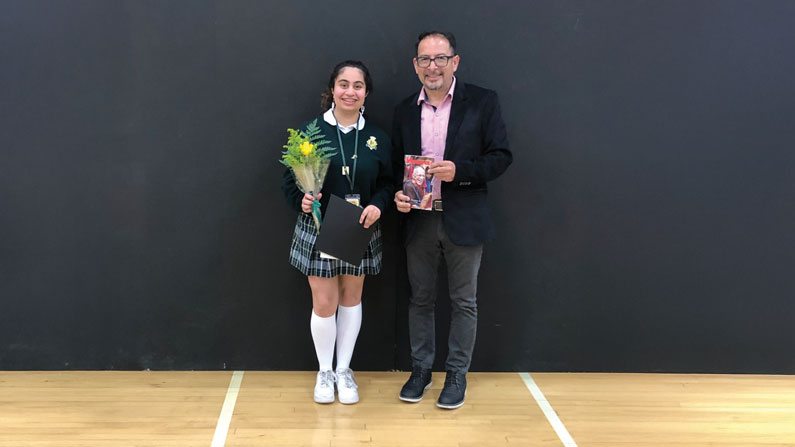
Deacon Leonel Yoque, who works for Maryknoll Fathers and Brothers’ Mission Formation Ministry, awards a prize to Maryknoll Student Essay Contest winner Sophia Tejwani in Thousand Oaks, California. (Courtesy of Leonel Yoque/U.S.)
After years of waiting unsuccessfully to be approved for asylum, I applied for status under a new law to assist Central American migrants called NACARA 203. I was granted permanent residency and later American citizenship. In 2008, I returned to Guatemala. It was an emotional homecoming, as my heart was filled with joy as well as sadness for the time and the people I had lost.
Ordained a permanent deacon for the Archdiocese of Los Angeles, I completed a master’s degree in pastoral theology. I worked for nonprofit organizations serving neglected communities in Los Angeles until an opportunity arose to pursue mission ministry with the Maryknoll Fathers and Brothers.
For the past 16 years, I have served as a Maryknoll missionary disciple. Each year I lead mission immersion trips to several countries — including Guatemala. People from the United States can experience this beautiful country firsthand, connecting with its people and being enriched by their faith and culture, while also learning about their daily challenges and struggles.
For me, each trip allows me to heal the emotional scars of leaving Guatemala as a teenager. For this, and for his constant presence in my life, I am eternally grateful to God.
Reflecting on my journey, I realize that migrants are not just numbers; we are people with dreams, families and hopes for a better future. I am grateful for the opportunities I have had in the United States and the chance to reconnect with my homeland. But I also know others who have not had the same opportunities and are still living in the shadows. I pray that the dreams of our migrant brothers and sisters will also come true.
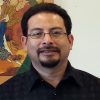
Deacon Leonel Yoque leads outreach to Hispanic Catholics for the Maryknoll Fathers and Brothers.
Featured image: Immersion trips to Guatemala include a visit to the Caminando Por La Paz neighborhood center founded by the late Maryknoll Father Thomas Goekler and now run by Maryknoll Affiliates. (Courtesy of Leonel Yoque/Guatemala)