The martyrdom of St. Óscar Romero, the Archbishop of San Salvador, was a powerful witness and an inspiration for the Church. He had made his own the plight of the vast majority of his flock and made them the center of his pastoral vision.
— Pope Leo, Dilexi Te
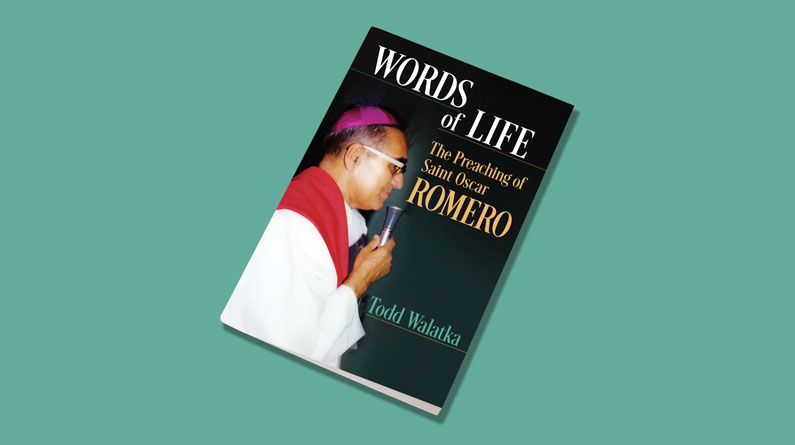
St. Óscar Romero, the archbishop of San Salvador, who was slain at the altar while saying Mass in 1980, is undoubtedly one of the towering figures of the modern Church. More than four decades later, we continue to meditate on and draw inspiration from his prophetic witness. At Orbis over the years we have published more than a dozen books by and about Archbishop Romero, including biographies, theological reflections, collections of his pastoral letters and excerpts from his speeches and writings.
It is arguably Romero’s homilies that provide the best and most intimate portrait of his testimony. Yet that message has been hard to access. The complete translation of Romero’s homilies from 1977-1980 is published in four large volumes totaling 2,500 pages. Todd Walatka, a professor of theology at the University of Notre Dame, aptly discerned the need for a more accessible entry.
In Words of Life: The Preaching of St. Óscar Romero, he has selected a dozen of St. Romero’s most iconic sermons, beginning with his homily following the assassination in 1977 of his friend, Jesuit Father Rutilio Grande, and concluding with his final homily on the day of his own assassination three years later.
Broadcast live by radio from his cathedral in the capital, San Salvador, Romero’s Sunday homilies were a national and ecclesial event. While reflecting aloud on the Word of God, he related the Gospel to the daily events in El Salvador. Addressing the hopes, joys and anguish of his suffering people, he was also careful to document the accelerating incidence of human rights violations. While his words sustained the faith of the poor, they also inflamed his powerful enemies.
However, if Romero’s preaching had political implications, these sermons demonstrate how deeply his response to the world was rooted in his profound incarnational faith. Just as the Incarnation is the central mystery of the Christian faith, he urged his flock to incarnate the Gospel message in their own lives, through their commitment to both charity and justice.
Todd Walatka notes that it is difficult to distill Romero’s preaching into a single theme or idea. Perhaps, he says, “the closest would be his goal of articulating what it means to be the true Church of Jesus Christ. But … Romero’s goal wasn’t simply to provide a good, clear theology of the Church. He wanted his people to grow ever more fully into being the Church, into living out their identity as the people of God in El Salvador. In the midst of confusions, competing ideologies, and violence, he urged all — including himself — to put the Gospel at the center of their lives and feel the responsibility for living it out.”
All the while, he knew the risks he was taking. Yet he persisted to the end.
In his final homily, just moments before his death, Romero spoke these words: “You just heard the Gospel of Christ: We must not love our lives so much that we avoid taking the risks in life that history calls for. Those who seek to shun danger will lose their lives, whereas those who, for love of Christ, dedicate themselves to the service of others will live. They are like that grain of wheat that dies, at least in appearance. If the grain does not die, it remains alone. If it yields a crop, it is because it dies, allowing itself to be immolated in the earth.”
Words of Life: The Preaching of St. Óscar Romero is available to order from Orbis Books.