Ahumble ceremony was held in the Little Tokyo section of Los Angeles as the world recalled the 80th anniversary of the atomic bombings of Japan and the incarceration of Japanese and Japanese Americans in the United States during World War II.
The ceremony on Aug. 31, 2025, was an occasion to bless a multi-wall mural at the only officially Japanese Catholic Church in the United States. Bishop Matthew Elshoff celebrated a bilingual English-Japanese Mass, with pastor Father Doan Hoang concelebrating. Long-time parishioners wanted the mural, painted by local artist Erin Yoshi, to reflect both their sad memories of years of suffering and the joys of their collective Catholic life. Maryknoll holds a special place in that story.
Outreach to Japanese Catholics in Little Tokyo began in 1912, when the Bishop of Hakodate, Japan, sent a priest to attend to the pastoral needs of the community. In 1920, Rome assigned Maryknoll to assume that role.
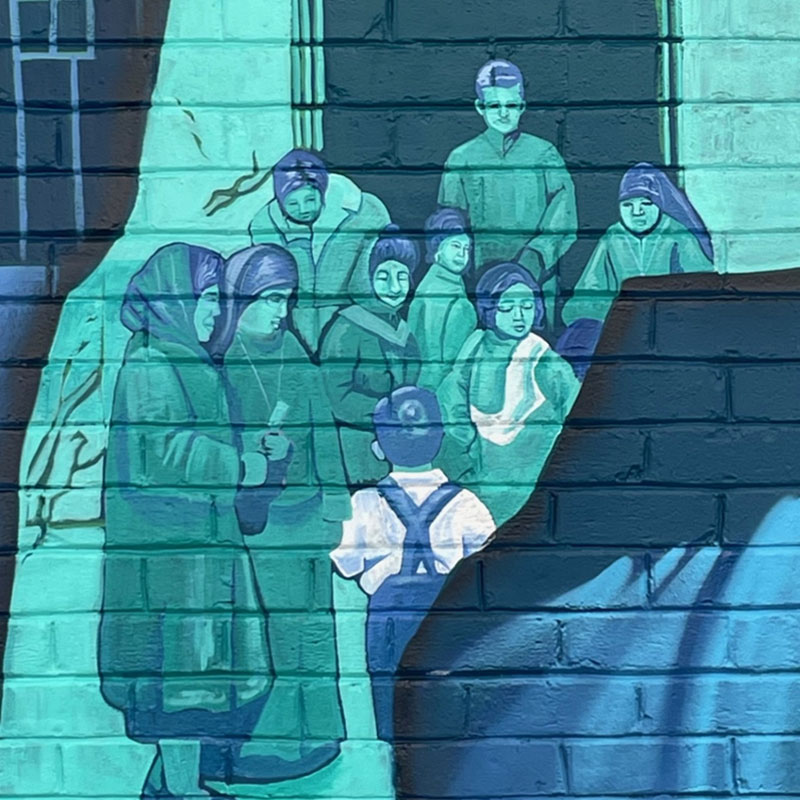
A scene in the mural “The Spirit of Our Roots” depicts Maryknoll Father Hugh Lavery and Maryknoll Sisters Mary Bernadette Yoshimochi and Susanna Hayashi offering pastoral care at the Manzanar internment camp. (Joseph Donovan/U.S.)
A parish was established with three focal points: a school, an orphanage and the church, named after St. Francis Xavier, the first missionary to introduce Christianity to Japan. During those first decades, Maryknoll Father Hugh Lavery expanded the parish services and facilities. The Maryknoll Sisters were enlisted to run the school, which included a large multipurpose hall. School bus service began with Maryknoll Brother Theophane Walsh as the driver. Father Lavery also helped the Maryknoll Sisters acquire property in Monrovia, California, for use as a sanatorium for Japanese patients with tuberculosis.
The parish grew steadily until its greatest trial: the attack on Pearl Harbor in 1941. Maryknoll met the challenge head-on in what was to become one of our mission movement’s finest hours.
The school hall became a meeting place for the anxious Japanese Catholic community until the parishioners were evacuated to internment camps for the duration of the war. Since the school and church were now unused, parishioners’ possessions could be safely stored in them. Father Lavery also negotiated the sale of families’ homes at fair prices.
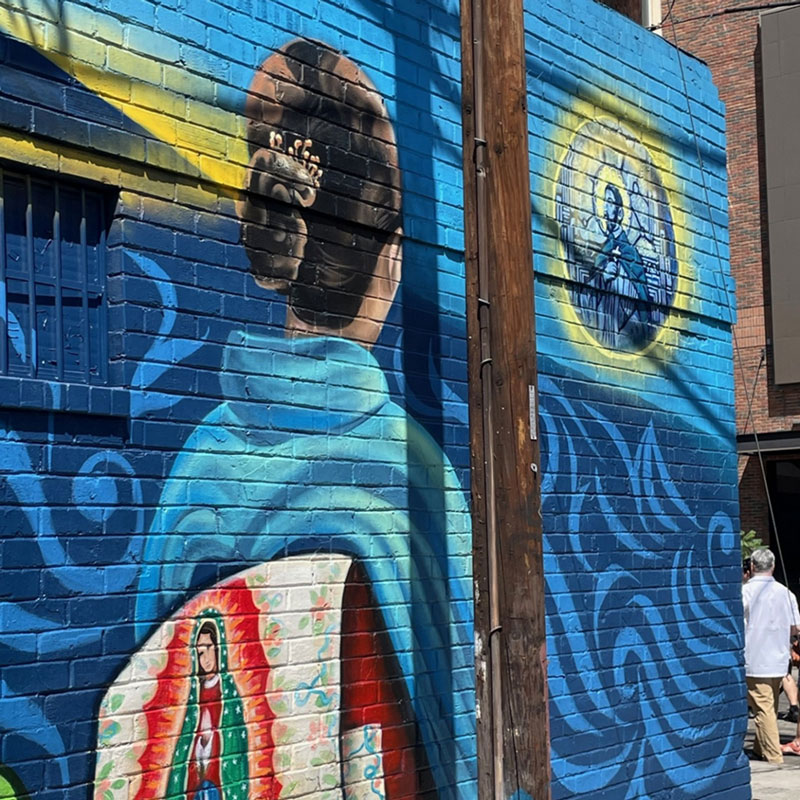
In the mural, artist Erin Yoshi painted a Japanese woman facing a portrait of St. Francis Xavier, patron of missions, for whom the chapel in Little Tokyo is named. The Virgin of Guadalupe is depicted on the woman’s traditional garment as an acknowledgment that the neighborhood is now predominantly Latino. (Joseph Donovan/U.S.)
As mass incarcerations continued, the Maryknoll priests, brothers and sisters continually visited the camps to catechize, encourage the people and celebrate the sacraments. Two Maryknoll sisters in particular are dearly remembered: Japanese-born Sisters Mary Bernadette Yoshimochi and Susanna Hayashi. Both were offered the protection of the sisters’ motherhouse in New York, but refused to abandon their parishioners. They were interned along with them at Manzanar, and thus accompanied the community in the camp until the end of the war.
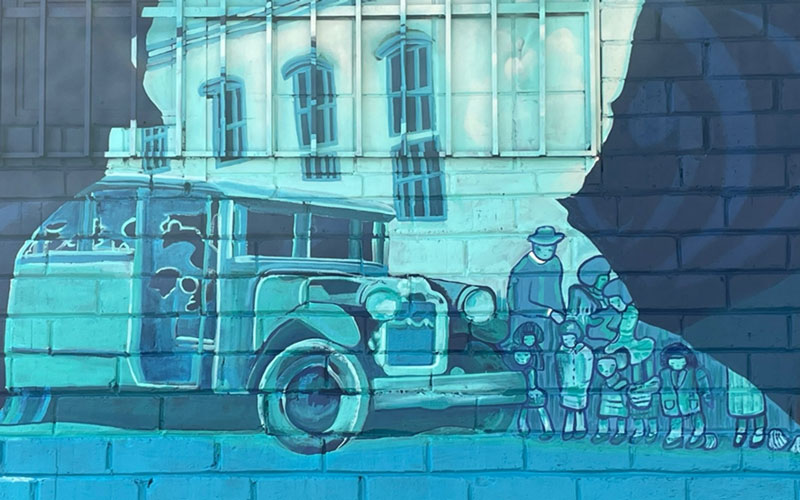
Maryknoll Brother Theophane Walsh is depicted serving as the parish school’s first bus driver. (Joseph Donovan/U.S.)
When the war did end, the families returned to Los Angeles. The church and school reopened, and parish life resumed. The school band, drum and bugle corps, volleyball teams, parish-organized picnics, karate club, the Catholic Family Movement, the Catholic Youth Organization and the Scouts revived their activities. Parish life thrived again, with a treasured new addition — an annual parish carnival! St. Francis Xavier became known throughout the city simply as “Maryknoll,” and as one family put it, “Maryknoll became our second home.”
This long and bittersweet history is celebrated in the inauguration of the parish mural, a tribute to the courageous and dedicated Japanese Catholics who suffered deep humiliation and tragic loss but remained ever confident in the faithfulness of their God and of the Maryknoll missioners who loved them.
Featured image: Members of Little Tokyo’s St. Francis Xavier Chapel in Los Angeles and Maryknoll Father Joseph Donovan (third from left) celebrate the blessing of “The Spirit of Our Roots” mural by Erin Yoshi (in orange dress). (Kokawa Photography/U.S.)