St. Óscar Romero’s photographer returns to El Salvador the shoes worn at his martyrdom.
As I held Archbishop Óscar Romero’s empty shoes in my trembling hands, I felt gravity heavier than their weight.
It was the evening of March 24, 1980. That fateful day had begun ordinarily at San José de la Montaña, where I was a seminarian, in San Salvador. Our daily routine proceeded normally — until the end of the 5:30 p.m. Mass, when devastating news shattered our world. Archbishop Romero had been assassinated while celebrating Mass at the Divine Providence Hospital chapel.
El Salvador’s political situation was deteriorating dramatically. Violence engulfed the country as government forces committed widespread human rights abuses against civilians suspected of supporting leftist movements. Tensions had reached such extremes that Archbishop Romero felt compelled to directly address the armed forces in his Sunday homily, begging soldiers to stop the brutal repression sweeping the nation.
In a powerful sermon on March 23, 1980, Archbishop Romero spoke with unwavering moral clarity: “Brothers, you are members of our own people. You kill your fellow peasants … When faced with a man’s order to kill, God’s law must prevail: ‘Thou shalt not kill.’ No soldier is obligated to obey an order contrary to God’s law. It is time to reclaim your conscience.
“In the name of God, and in the name of this suffering people whose cries rise to heaven more loudly each day, I implore you, I beg you, I order you in the name of God: Stop the repression!”
This prophetic statement sealed his death sentence. Yet even as his words resonated through the basilica and across radio broadcasts nationwide, no one could have foreseen that his life would be taken the very next day.
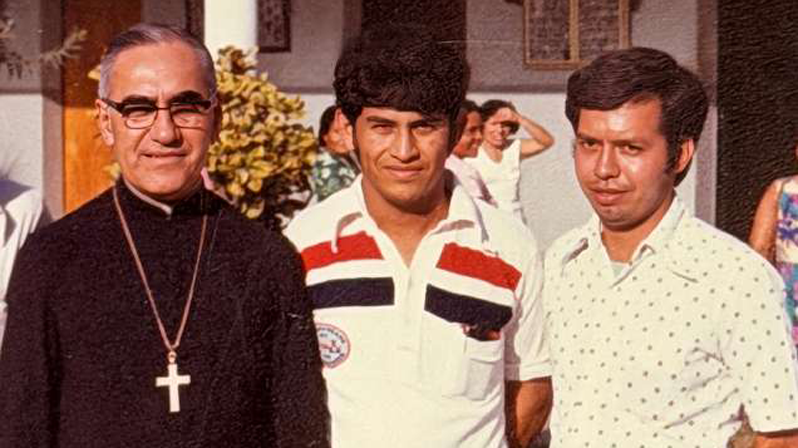
That evening at the seminary, Father Gregorio Rosa Chávez, our rector, approached me with grave urgency. He requested that I accompany him to the medical facility where emergency personnel had transported the archbishop’s body.
As darkness fell, the taxi ride — a blur of motion and dread — took us through the crowded streets of a city already erupting with grief, outrage and uncertainty. Upon arrival, we found Monsignor Romero surrounded by frantic doctors and weeping religious sisters. His body still retained warmth, and a single, precise bullet hole in his chest marked exactly where hatred had pierced his compassionate heart.
Mechanically I took photographs, using my camera as an emotional shield between myself and the unbearable reality unfolding before me. Monsignor himself had given me the camera to document the archdiocese’s work.
Trauma erased many details from my memory, the mind’s way of protecting us from what we cannot immediately process. Yet one image is etched in my mind: when his body was wheeled away for autopsy, his shoes remained behind on the floor, suddenly empty and abandoned.
I knew well those simple, worn-down shoes. I had seen them faithfully carry him through El Salvador’s dusty streets and roads, to remote villages and to the humble homes of its most impoverished citizens. They had also taken him to the pulpit, where he boldly spoke truth to power.
These emptied vessels had transported a man who walked alongside the suffering, who refused the comfort of silence when his people desperately needed a voice for justice. Without thinking, I carefully placed them in my camera bag.
As we returned to the seminary in stunned silence, El Salvador trembled on the edge of an unimaginable brutality. Our shepherd had fallen, and 12 years of civil war would claim over 75,000 lives. Half a million of us had to flee our country.
Throughout my four and a half decades in the United States, these shoes have accompanied me, tucked away safely yet always present. Silent companions witnessing my own journey, they saw me become a Franciscan friar and anchored me through life’s triumphs and hardships. I’ve occasionally shown them to trusted friends and colleagues, watching as understanding dawns on their faces while I explain what these ordinary-looking objects are. They carried a man of small physical stature and towering spiritual presence; they are the shoes of a prophet, a saint who spoke when others fell silent.
They officially became relics with St. Óscar Romero’s canonization, which I attended in 2018 along with his friend and disciple Cardinal Rosa Chávez — El Salvador’s first cardinal.
But in time I came to realize that the shoes were like immigrants who yearned for their birthplace. The worn leather that once cushioned Monsignor’s feet belonged in the country whose soil is embedded in their soles.
So, 46 years later, I returned the shoes to their homeland.
On January 14, while on pilgrimage with the Maryknoll Fathers and Brothers in El Salvador, I had the privilege of presenting Monsignor’s shoes to Sister Tránsito de la Cruz, superior of the community at Divine Providence Hospital. There, the Missionary Carmelites of St. Teresa lovingly tend a memorial museum in the little apartment where St. Romero lived, and the delivery took place in the chapel where he was martyred.
The priests and deacons on the Maryknoll pilgrimage seemed to hold their breath as Sister Tránsito received the shoes. Her weathered hands trembled slightly — perhaps remembering the times when St. Romero himself walked these grounds, bringing comfort and courage to the sisters during uncertain times.
“These belong here,” she whispered, tears glistening in her eyes. “They have completed their journey.”
As they passed from my hands to hers, I felt both emptied and fulfilled.
Others on the pilgrimage took turns holding the shoes, sacred objects connecting present-day servants to the one who had gone before. “Just holding them inspired in me a tremendous call to continue his witness of walking with the struggling poor in total faithfulness to Christ,” said Monsignor Arturo Bañuelas of El Paso, Texas, who presided our Mass. He has served in priestly ministry for five decades.
“I held the tiny shoes of a giant,” reflected Father Iván Montelongo, who at 32 was the youngest of the 19 participants on pilgrimage. Ordained in 2020, he is director of vocations for the Diocese of El Paso. “As I held them, I prayed for the courage to go where Monsignor went, toward the discarded. As I kissed them in veneration, I felt what Isaiah might have felt when the heavenly ember touched his lips.” (Is 6:1-9)
In giving the shoes away, I gained newfound clarity. They represent a path that few possess the courage to walk — one of sacrifice and unconditional love, placing one foot before the other, even when each step brings you closer to crucifixion.
The shoes now rest where they belong, in the museum alongside Monsignor’s other modest possessions, including the vestments he wore at the time of his martyrdom and photos of his pastoral visits. All who make the pilgrimage to honor his memory can contemplate their significance.
But St. Romero’s legacy is not confined to museums or memorials. It lives in continuing acts of remembrance, in the courage of those who still speak truth to power, and in the hope that justice will someday walk freely in the land our martyr loved.
Featured image: Franciscan Brother Octavio Durán presents the shoes St. Óscar Romero wore when he was martyred to Sister Tránsito de la Cruz (center), superior of the Missionary Carmelites of St. Teresa local community, and Sister Reina Mancía, caretaker of the memorial museum at Divine Providence Hospital in San Salvador, El Salvador. (Courtesy of Octavio Durán/El Salvador)