A Maryknoll priest spends a lifetime in mission accompanying the people of El Salvador and honoring their martyrs.
In the city of San Salvador, a street mural portrays a memorable Mass. One side of the painted altar shows images of devastation. On the other, vivid colors bring to life a thriving community. A quote on the altar cloth reads, “Guard this treasure.” Maryknoll Father John Spain has spent his life in mission carrying out this message.
Father Spain, known affectionately as “Padre Juan,” began his five decades of service in Central America in 1971. Ordained the previous year at the age of 26, he studied Spanish in Bolivia before arriving in El Salvador, a small country the size of Massachusetts.
The mural illustrates the reality Father Spain entered into as a young missioner. Depicted at the altar are martyrs of the Salvadoran church — including Saint Óscar Romero. “I came in June, and I met him in August,” Father Spain recalls. “The Church here has been shaped by him, along with so many others.”
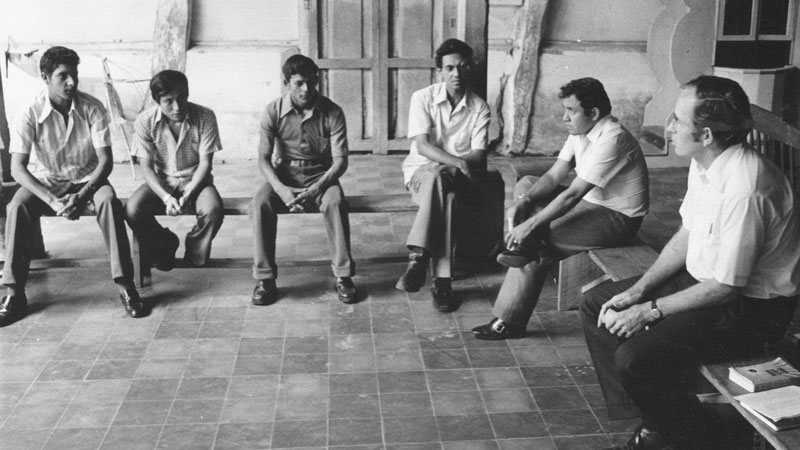
Father Spain ministered first in the peripheries of the capital. Most residents lived in housing projects built for factory and construction workers who migrated from rural areas. “Our pastoral challenge was to restore their sense of community and revive the faith they received growing up,” Father Spain says. “You may have a job, and even housing, but where was your community?”
The answer was found in base ecclesial communities. “They start talking about their lives, Scripture, the teachings of the Church, and it gives them a community identity again,” Father Spain says. “People come alive with other people.”
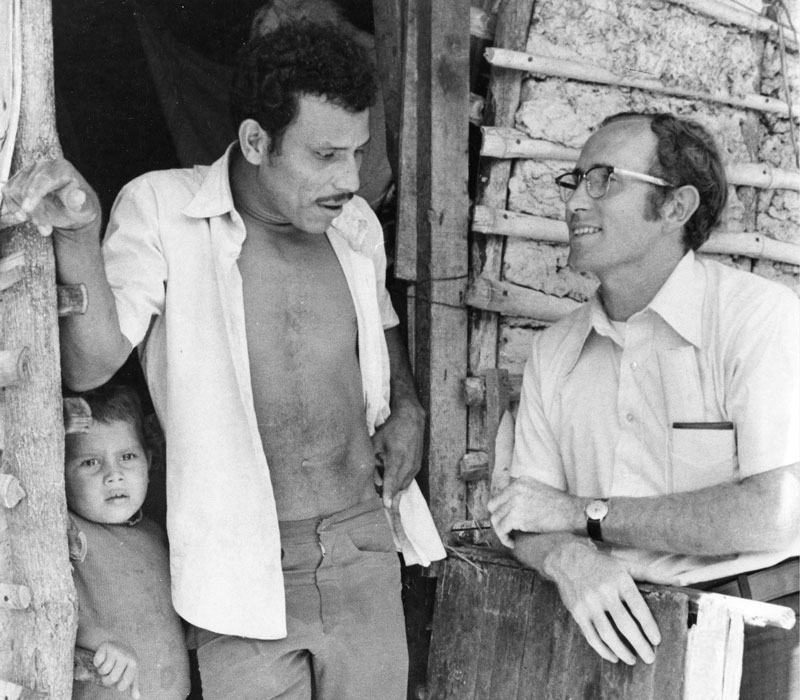
In 1978, Maryknoll was entrusted with the rural parish of San Pedro Apóstol in Ciudad Barrios — Óscar Romero’s hometown. Parishioners included subsistence farmers and coffee plantation laborers. “We were invited in to share the deep faith and love of the land,” Father Spain says. “There was poverty, but people had that sense of family, community, identity. They knew who they were.”
The missioner had served on the priests’ council and worked under Father Fabián Amaya, director of the diocesan newspaper and radio; these roles gave him a wide panorama. In both urban areas and the countryside, Father Spain recounts, there was great excitement, “an effervescence,” about implementing the teachings of Vatican II and the Latin American bishops conference.
Saint Pope Paul VI’s 1975 encyclical Evangelii Nuntiandi (On Evangelization in the Modern World) heightened the enthusiasm. “The encyclical came like the May rains,” Father Spain says, echoing San Salvador’s archbishop at the time, who was succeeded by Monsignor Romero.
The “May rains” kept hope alive as El Salvador hurtled toward a civil war that claimed 75,000 lives. Social unrest grew throughout the country, and in the capital a state of siege was declared. Extrajudicial military units known as “death squads” targeted Church and community leaders suspected of “subversion.” “We knew different people who were killed,” Father Spain recalls sadly.
Archbishop Romero addressed the crisis in widely broadcast sermons. “There is a way to know if God is near us,” he said in a homily. “God is close to those who care about the hungry, the naked, the poor, the disappeared, the tortured, the prisoners, the suffering.”
“He had that gift of expressing the voice of the people, the voiceless,” Father Spain says.
On March 24, 1980, while saying Mass, Monsignor Romero was assassinated by a sniper. On Dec. 2 that same year, Maryknoll Sisters Ita Ford and Maura Clarke, Ursuline Sister Dorothy Kazel and the lay missioner Jean Donovan were murdered.
“Why did the sisters stay at what they were doing, in spite of threats? Why did Romero stay?” Father Spain asks. They were committed, he says, “to the basic conviction that this is what Jesus calls us to.”
“Father John Spain is a witness to the martyred North American churchwomen and Saint Óscar Romero. He comes alive when talking about them,” says Kevin McCarthy, who has led four immersion trips to El Salvador with Maryknoll’s Mission Formation Ministry. “He has a historian’s mind for details and facts, but because he knew them, the information he shares is lasting and powerful.”
“Their lives have not been in vain,” Father Spain says resolutely. “They point a direction for our lives and what we should be doing.”
Born in Troy, New York, John Spain was pointed in the direction of mission from an early age. The third of eight siblings, he grew up reading Maryknoll magazine. “On Mission Sunday every year in our Catholic newspaper, there was a full-page spread of the 300 missionaries from the Albany diocese, including many Maryknollers,” he recalls. Spain left Holy Cross College to join the Maryknoll Society.
The year after Romero and the churchwomen’s murders, Father Spain and other Maryknoll priests were asked by their superiors to leave El Salvador because of threats. He served for nine years in nearby Nicaragua.
In December of 1991 — the cusp of the signing of the peace accords — Father Spain returned to the country he calls home. He joined two Maryknollers, Fathers Ronald Hennessey and William Boteler, in San Ramón at the parish of El Buen Pastor, which had lost some 600 members. Their main ministry, he says, “was to facilitate reconciliation and healing.”
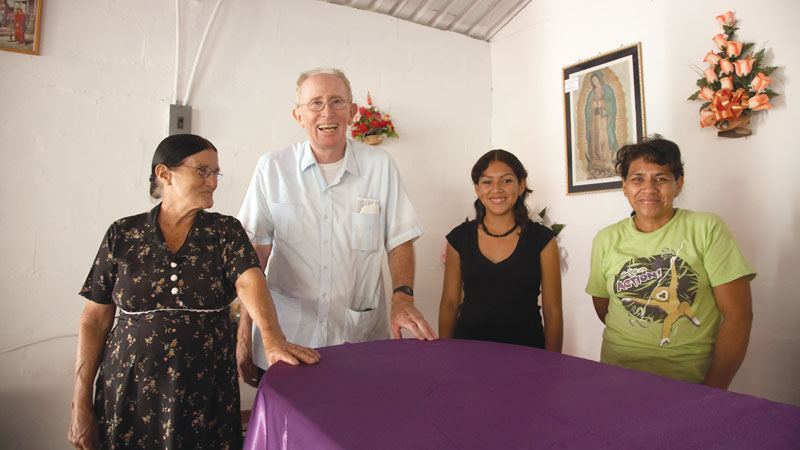
Father Spain eventually helped turn over the parish to the Archdiocese of San Salvador. Then he and Maryknoll Father James Lynch opened a new parish in San Roque, where they rebuilt homes destroyed by earthquakes. “Starting a new parish means getting to know the people,” says Father Lynch, who is now vicar general of the Maryknoll Society. “It was important to listen to their stories, their joys and sorrows, because listening is the first step of evangelization.”
By 2005 the new parish church was inaugurated, with three chapels rebuilt, and that parish, too, was handed over to the archdiocese. “My mission has always been to support the local church,” Father Spain says.
“Even during the most difficult years, I didn’t go through it alone,” he says. “That’s the prized possession of my time here.”
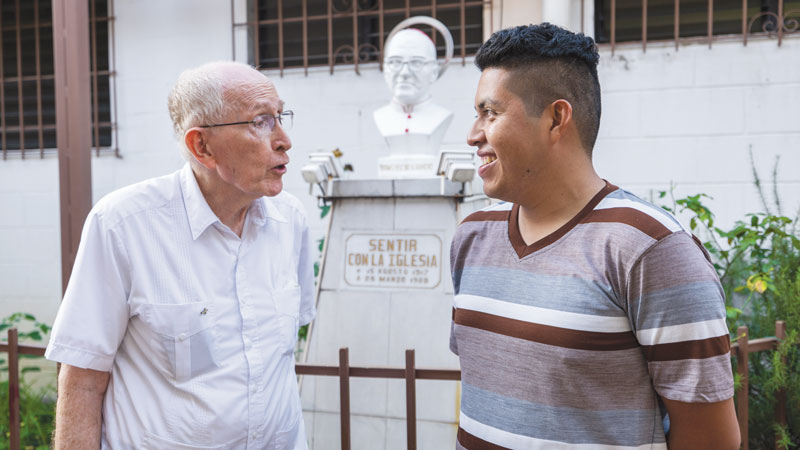
Father Spain chats with Cristo Salvador youth group member Ronald González Cornejo, whose mother and grandmother have served with Maryknollers. (Octavio Durán/El Salvador)
Father Spain, 82, has served since 2010 at Cristo Salvador Church in the Zacamil neighborhood of Mejicanos in metropolitan San Salvador. The parish — an oasis for communities marked by emigration and gang violence — formerly included the territory of El Buen Pastor.
The pastor of Cristo Salvador, Father Joaquín Álvarez Campos, says their friendship goes back even further. “I met Father John when I was a seminarian,” recalls Father Álvarez, who ministered throughout his country’s civil war. He keeps a portrait of Saint Óscar Romero in the church. “His expression fills me,” he says. “It gives me strength to help the people.”
In addition to maintaining the church and two chapels, the parish runs a youth ministry and a ministry for the sick, in which Maryknoll Father John “Jack” Northrop served until returning to the States last year. “They walk with the people,” Father Álvarez says of the Maryknollers. “We make a good team.”
Mission is about “being close to the poor,” Father Spain says. “They understand what suffering is, they know what loss is. But they also know what hope is. It’s wonderful to be with people who know what life is all about.”
Featured image: Father Joaquín Álvarez Campos and Maryknoll Father John Spain (right) visit the tomb of Saint Óscar Romero in San Salvador’s cathedral. (Octavio Durán/El Salvador)