A missioner on wheels, Maryknoll Father Robert McCahill marks 50 years of service to poor families with disabled children in the South Asian country of Bangladesh.
Father Robert T. McCahill, a Maryknoll missioner who works in health care for poor, disabled people in Bangladesh, marks 50 years of service in the country this December.
Over his five decades in Bangladesh, Father McCahill has served in 13 administrative districts in the Muslim-majority nation, spending three years in each one serving the people there. He left Srinagar in Munshiganj district near Dhaka in late November after completing three years there, though he does not yet know where he will go next.
“I think that just as Jesus was not tied to one place and asked to spread the word of God, I travel around and reach people of all religions with love and work,” Father McCahill told CNA on Nov. 18.
Born in Iowa in 1937, Father McCahill later moved to Indiana due to his father’s work. In 1964, he was ordained a priest and went to the Philippines that same year.
“Brother Bob” serves among Muslims
In 1975, he and four other priests came to Bangladesh at the invitation of Archbishop T. A. Ganguly of Dhaka, the capital of Bangladesh. After learning Bengali for a year, his first place of work was in the northern district of Tangail, where he remained for nine years.
In Bangladesh, he is known as “Bob Bhai” — Brother Bob. Father McCahill was given this name by a Muslim friend who thought Bangladeshi Muslims would have difficulty pronouncing his full name, and he is still known by this name in the villages where he serves.
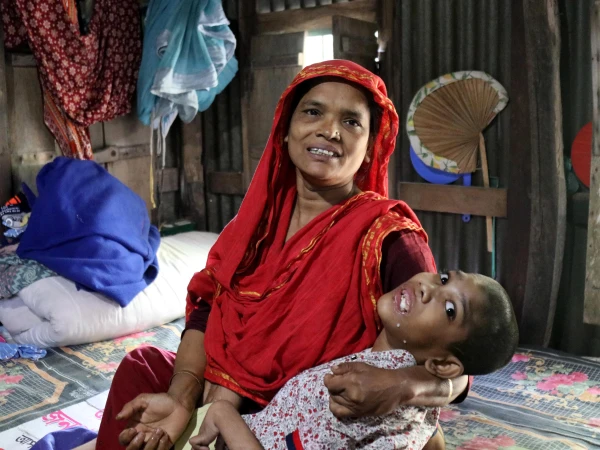
“My only son has been disabled since birth. He cannot walk or speak. I have seen many doctors but to no avail,” said Abdul Mannan Khan, 45, a Muslim resident of Munshigonj district.
“Bob Bhai often comes to my house, laughs and jokes with my son. Now we are getting treatment in the hospital through him. I don’t need any money,” Khan told CNA.
His 15-year-old son Abu Mosa Khan is the only child in the family, and his parents care for him devotedly. But the family says that no one gets along with the disabled boy the way Father McCahill does.
“Not everything is possible with money alone. Many great things are possible with love, like Bob Bhai is doing,” Khan said.
Simple lifestyle in apostolic poverty
Wherever he lives, Father McCahill rents a small room, unless someone gives him a free one. In Srinagar, authorities gave him a 5-by-8-foot space in a schoolroom, separated by tin walls. The dimly lit room contained a pile of clothes, a simple wooden bed, a tattered mosquito net, a basic electric light and a fan. It also had a kerosene stove for cooking, a few small utensils and a bicycle.
The missioner rides a bicycle at least 12-15 miles every day to visit rural villages, see disabled children, and take them to different hospitals for treatment as needed.
“Bob Bhai comes to our house early in the morning on his bicycle,” said a villager named Farman, 83.
Farman’s grandson Rakibul, 8, became disabled a year after birth and cannot walk or speak. His mother has remarried and lives elsewhere, and his father no longer cares for him, so Rakibul lives with his grandfather.
“After undergoing treatment in many places, Rakibul is now getting treatment in Dhaka free of cost on Bob Bhai’s advice, and now he is on the path to some improvement,” Farman said.
A passion for riding bicycles
Since his youth, the missioner has had a great passion for bicycles. When he came to Bangladesh, where at the time roads were not well developed, he found he could get around best by bicycle. So he chose a bike as his vehicle.
“Among other reasons, the main reason is simplicity, and bicycles are the vehicle of poor people. At the same time, cycling also keeps the body healthy, so I ride bicycles,” Father McCahill said.
“Also, when I ride a bicycle, many people ask me various questions. I can easily answer them while standing,” the cycling missionary said.
Father McCahill finds peace in his life by serving people. “I believe lov[ing] one another is the key to happiness,” says the missioners, who adds that he will continue to serve as long as he can walk. He enjoys discovering one new area after another and meeting new people. He has not faced any major difficulty in the country, despite the fact that around 90% of the population is Muslim and less than 1% is Christian.
“First, there’s suspicion — expecting and getting it. By the second year, there are many people who trust you, and that builds during the year, a year of trust-building. By the third year, there is affection for me. And so I knew at that time, at the end of the third year, I could leave and do the same thing in another town,” he said.
He believes that a priest should not only celebrate Mass inside a church but also preach the word of Christ everywhere.
“I celebrate Mass here myself every day,” he said. “I want to live like this, and when I die, I want to be buried in this country.”
Featured image: Abdul Mannan Khan and his disabled son Abu Mosa Khan meet with Maryknoll Father Robert McCahill at their home in Munshigonj district, Bangladesh, on Nov. 18, 2025. The priest visits villages daily to find disabled children and connect them with medical treatment. (Stephan Uttom Rozario/Bangladesh)