A Maryknoll team in Guatemala cares for HIV-positive people at Hospicio Santa María, a hospice that is also home to a thriving organic farm.
A young mother named Norma nestles 2-month-old Pedro in her arms, carefully positioning his baby bottle. Norma — who also has a 3-year-old daughter — learned to bottle-feed only recently, after arriving at Hospicio Santa María six months ago, pregnant, severely malnourished and HIV positive.
“It’s not the first time we had a baby born at the hospice,” explains Brenda Ambrocio, the nurse coordinator. “But this case is very special.”
Norma, 28, is a single mother. She and her daughter had lived with her parents in a tiny house. “Nine people lived there in extreme poverty,” says Maryknoll Sister Delia “Dee” Smith, director of the hospice. When Norma was diagnosed with HIV, her toddler was put into foster care, and Norma came to Hospicio Santa María, in the town of Pajapita in the department (state) of San Marcos, to have her baby.
“Through ultrasounds, we knew he was also malnourished,” Brenda says. “Here Norma got milk and atoles (corn beverages), regular medication and excellent nutrition. The baby was born at 7 pounds and 6 ounces, a good size.”
“A nurse at the hospice is a jack of all trades,” Sister Dee says. Brenda not only taught Norma how to prepare baby formula (since HIV can be transmitted through breast milk), but also connects Norma with her daughter online for their weekly virtual visit and accompanies her to family court.
This multifaceted approach is characteristic of Hospicio Santa María. The home, which can hold up to 16 patients, grew out of Sister Dee’s work with Project Life, an organization for HIV/AIDS advocacy.
“Everything started with Project Life,” says Bielman Juárez Ambrocio, Brenda’s brother, who volunteered in his youth before formally joining the staff to work in programs.
At first, the organization offered only HIV testing and prevention programs. “Antiretrovirals did not exist here in Guatemala then,” says Bielman, who is studying for degrees in law and pedagogy. “Sister Dee and the doctors she worked with were forerunners.”
“We at Proyecto Vida (Project Life) were the first outside the two national hospitals in the capital to offer antiretrovirals, with the support of Doctors Without Borders,” says Sister Dee, who has served in Guatemala for over three decades. When The Global Fund to Fight AIDS, Tuberculosis and Malaria came, she was president of the country coordinating mechanism that connected health ministries and organizations serving people with HIV/AIDS throughout Guatemala.
Antiretrovirals are medications that stop the HIV virus from replicating, thus protecting the immune system and preventing the progression to AIDS. They can even block transmission from mother to child — such as Norma and Pedro. The newborn, who has been tested repeatedly, is not infected.
This medical miracle in Pajapita was made possible through a labor of love.
Sister Dee had been joined at Project Life in 1997 by Maryknoll Sister Marlene Condon, a nurse practitioner with public health experience in Chile. Sister Dee, who has a background in teaching, focused on advocacy and education, while Sister Marlene carried out home visits. Because Pajapita is close to the border with Mexico, it is heavily transited and has high rates of HIV and AIDS. The sisters saw the needs of abandoned AIDS patients.
“They were isolated as terminal patients,” recalls Brenda, who has worked at Hospicio Santa María since it opened its doors in 2006. “Emaciated, dirty, they were left to die, because who wanted to touch them, clean them?” The sisters started the hospice, she says, so that people could “die with dignity.”
With the care they received at Hospicio Santa María and the introduction of antiretrovirals, however, patients no longer came to the hospice to die, but to recover. More than 400 patients have found a home there over these 20 years.
“Every case is different,” says administrator Carlos Sandoval. A 71-year-old man has lived at the hospice since shortly after it began. Another patient, 20, was kicked out of the house when his parents learned he had HIV. Depression is not unusual, Carlos adds. “Many patients need psychological support because of family rejection, losing their homes, or being fired from their jobs,” he says.
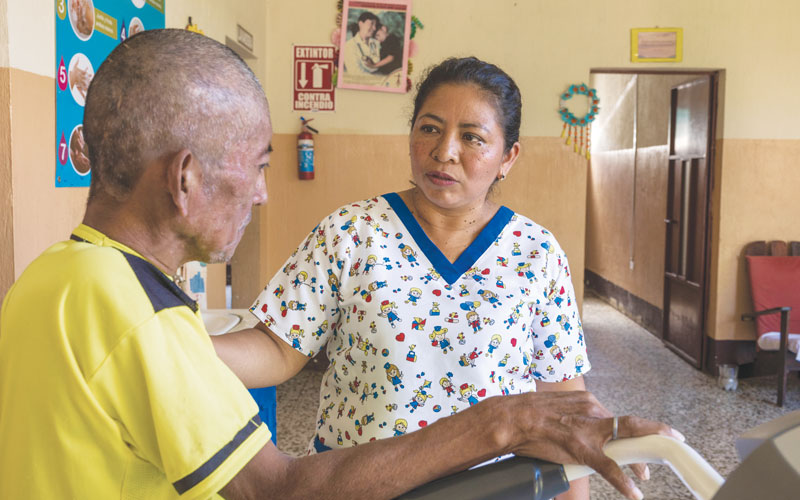
The beautiful setting helps lift the spirits of patients, who are referred by their local HIV hospital clinics. They swim daily in an inground pool and enjoy home-cooked meals. In addition to physical therapy, they are offered reflexology, Swedish massage and aromatherapy. Two friendly Labrador retrievers, Cooper and Perla, offer affection and companionship.
Sister Marlene served as hospice director until 2016 and returned to the States soon afterward. She died in 2022, but her spirit of service lives on.
Carlos, who has a degree in business administration, tackles plumbing problems. The six nurses lend a hand in the gardens. The men on staff take turns on night watch, and once a month everyone pitches in for deep cleaning. Carlos and Bielman have become Maryknoll affiliates.
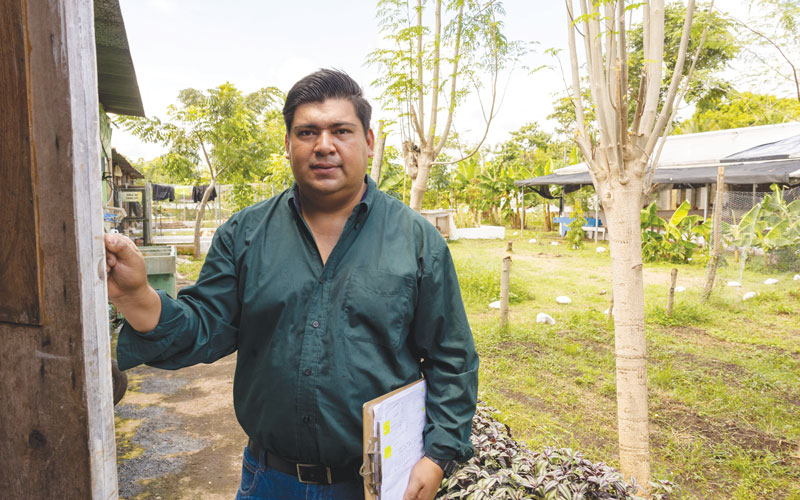
A third affiliate has worked with Sister Dee since 2010. Santos Vásquez Hidalgo, an agronomic engineer, oversees the hospice ecofarm. It took 10 years of cover crops and organic fertilizer to build up the soil, he says; crop rotation keeps it from becoming depleted. Now, lush gardens attract numerous butterflies, unlike most parts of arid San Marcos.
In addition to offering cool, restful spots for patients and staff, the ecofarm provides for the hospice’s daily meals. “We grow what the nutritionists request for our patients recovering from malnutrition,” Santos says. He prioritizes fruits and vegetables that boost the immune system and maintain healthy intestinal flora in people taking heavy medications.
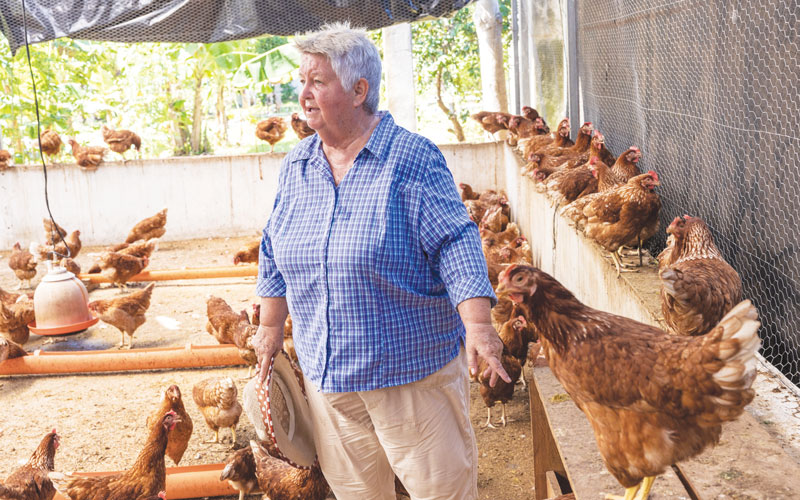
The hospice raises 150 broiler chickens, 300 egg-laying hens and a smaller number of free-range chickens. Beehives are kept at a separate location. “With those 70 hives, in 2024, we produced 1,005 liters of honey,” Santos says. Eggs and honey are sold to generate income.
The ecofarm recently hosted 150 schoolchildren from the nearby primary school, who came to learn about sustainable practices. Each student was given two tree saplings to take home.
“Our team has a heart and mission for the people,” Sister Dee says.
In the property’s large conference room, Project Life staff have trained two cohorts of women from poor communities to support their peers suffering from domestic violence (see separate story online).
As government agencies and nongovernmental organizations reel from cuts by funding sources such as the United States Agency for International Development (USAID), Sister Dee notes, the services offered by Project Life and Hospicio Santa María are needed more than ever.
Featured image: A young mother and her baby find a home at Hospicio Santa María, a home for HIV-positive and AIDS patients run by a Maryknoll sister and three Maryknoll affiliates. The hospice grounds include organic orchards and gardens, as well as an aviary. Located in the town of Pajapita in the department (state) of San Marcos, Guatemala, the property also houses the administrative offices of Project Life, an advocacy and educational organization that combats HIV/AIDS. (Octavio Durán/Guatemala)
FUNDING CUTS TO HIV/AIDS SERVICES IN GUATEMALA
UNAIDS estimates that 33,000 people in Guatemala live with HIV/AIDS. In 2024, 78% of them were in antiretroviral therapy, and the number of deaths has plummeted since the virus peaked in 2002. Guatemala’s adult prevalence rate is among the lowest in Latin America, according to the nonprofit The Borgen Project, due to “persistence and partnership.” NGOs had hired local outreach workers to keep records of transmission and to follow up with patients who missed appointments.
With UNAIDS losing half of its funding due to USAID cuts, Sister Dee says, a quarter of the personnel in HIV hospital clinics were laid off. Outreach workers were even more severely impacted. “When USAID pulled out, these NGOs collapsed,” she says. “So many projects have just disappeared.”
Although Hospicio Santa María and Project Life did not receive direct funding from USAID, Sister Dee says the loss of resources for patients living in poverty is felt deeply across Guatemala: “It is a real struggle for people.”