Pope Leo joins the U.S. bishops in condemning the mistreatment of immigrants in the country, including many here legally.
The Catholic Church has emerged with a united voice on immigration, one that is heard from parishes around the country to the Vatican, where our Chicago-born pope has made clear his disapproval of the mass deportations and mistreatment of immigrants.
Pastors and parishioners across the country were already responding to the needs of newcomers — indeed, some have been assisting migrants and immigrants for decades. The United States bishops went further this past autumn, issuing a “special message” during their annual assembly in Baltimore.
The bishops signaled the alarm and urgency with which they view the current campaign of mass deportations. It was their first special message in over a decade. Also remarkable, the message received overwhelming support: 216 votes in favor and only five opposed, with three abstentions.
Pope Leo XIV personally underscored the message, urging U.S. Catholics and other people “of goodwill” to read it. The pope condemned the “extremely disrespectful” treatment of immigrants living “good lives — many of them for 10, 15, 20 years” in the United States.
“We have to look for ways of treating people humanely, treating people with the dignity that they have,” the pope said. “If people are in the States illegally … there are courts. There is a system of justice” to address that. He added, “no one has said that the United States should have open borders.”
Maryknoll missioners have worked in longstanding ministries to migrants, immigrants and refugees — whether they are fleeing oppression and violence, displaced by natural disasters and climate change, or seeking immediate survival and eventual integration — both overseas and in the United States.
Father Lance Nadeau, the superior general of the Maryknoll Fathers and Brothers, says missioners are seeing the consequences of the administration’s anti-immigrant policies locally in Westchester County, New York, where Maryknoll is headquartered; in Chicago, where some of its seminarians study; in El Paso, Texas, where Maryknoll priests, sisters and lay missioners have served for years; and in various areas from California to Florida.
“The physical abuse and conditions that people have to experience in detention are terrible,” Father Nadeau says. “It’s outrageous that they’re breaking up families.”
He said the Maryknoll Society, along with Maryknoll Sisters and others in the Westchester area, are part of a coalition seeking to help immigrants now living in fear. Responses range from providing food assistance for those afraid to leave their homes to protesting the government’s actions and tactics.
“Our hope is to address the most urgent needs of immigrants who are in danger,” says Sister Teresa Hougnon, president of the Maryknoll Sisters. “We’re talking about food security, accompaniment and child safety.”
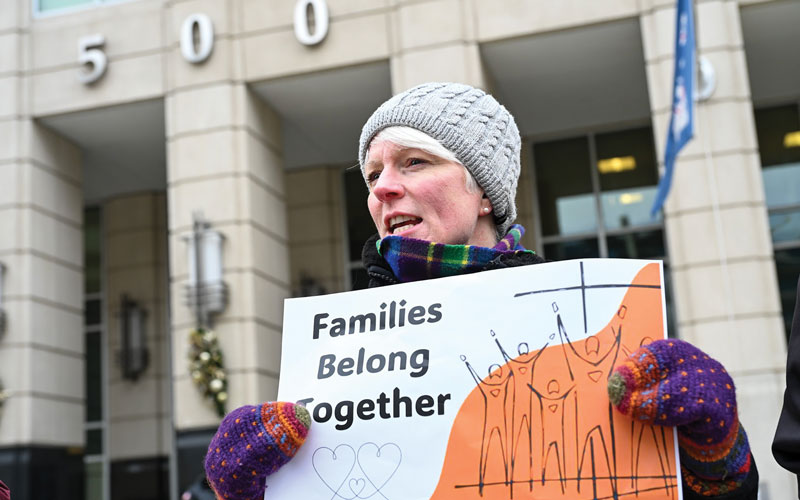
Susan Gunn, director of the Maryknoll Office for Global Concerns, vigils outside the U.S. Immigration and Customs Enforcement headquarters. (OSV News/Leslie E. Kossoff/U.S.)
Both Sister Hougnon and Father Nadeau say the current restrictions on immigration are impacting vocational candidates from overseas. Tighter scrutiny for entry into the United States has forced the Maryknoll Sisters and the Maryknoll Fathers and Brothers to restructure their formation programs for foreign candidates. The Sisters have taken foreign vocations almost since their founding, while the Society began welcoming prospects from mission countries a few years ago.
“They’re now going to the Philippines,” Sister Hougnon says, explaining that the congregation has opened a formation house for the novitiate in Manila.
The Society has done the same in Nairobi, Kenya, Father Nadeau says, establishing a novitiate there after some candidates were denied visas to study in the United States.
Sister Hougnon says that one elderly Maryknoll sister, who holds a green card, was so severely scrutinized upon returning to the United States from mission overseas that she opted to remain at Maryknoll for the time being, fearing she might be denied re-entry in the future.
The bishops’ message on immigration opened with a litany of concerns, among them “a climate of fear and anxiety” around the “vilification of immigrants,” conditions in detention centers and lack of access to pastoral care, as well as the arbitrary elimination of categories of legal status for people already here.
“We are grieved when we meet parents who fear being detained when taking their children to school and when we try to console family members who have already been separated from their loved ones,” the bishops said, explicitly stating, “We oppose the indiscriminate mass deportation of people.”
For some, the bishops’ statement isn’t enough. Redemptorist Bishop Bruce A. Lewandowski, of Providence, Rhode Island, is one of them.
“Immigration isn’t politics. It’s part of our DNA as people of faith,” Bishop Lewandowski said at a gathering of Church and pastoral leaders convened in Providence in early December at the Cathedral of Saints Peter and Paul. “God commands us to welcome the immigrant, to love the foreigner,” he said.
“One by one, moms and dads, husbands and wives (are) plucked out of communities, sent on a plane to Guatemala and Mexico,” said Bishop Lewandowski. “It is a strategy to destabilize the family. … None of the people I know who’ve been taken are murderers, drug traffickers, rapists, terrorists or criminals of any kind. All they did was cross the border like Abraham, Moses, Sarah or Jacob — like Jesus, Mary and Joseph.”
He calls for “a faith-based movement, a broad and far-reaching coalition to flood Washington with advocacy and advocates” akin to the Civil Rights Movement. What if, he asked, “we just started sending busloads of people like ourselves to Washington, to put before our government leaders the sorrow of our people who are being persecuted, who are being maligned and vilified, who are being detained and deported?”
Kevin Appleby of the Center for Migration Studies, one of the sponsors of the gathering, noted that St. John Paul II wrote that mass deportations are “intrinsically evil.”
“What does that mean?” asked Appleby. “It means they cannot be morally justified.” While deportation itself is not necessarily evil, he continued, the individual in question must present a threat to the community and due process must be followed — which isn’t happening in many cases in the current climate.
Maryknoll Lay Missioner Heidi Cerneka, an immigration attorney working for a nonprofit in El Paso, increasingly sees a disregard for due process.
“We have people who actually had some kind of status that ICE totally ignored,” she says. “Although [the immigrants] are playing by the rules, the government isn’t.” Consequently, she says, people who have a claim to remain in the States are nonetheless detained and deported, or they are held in such horrific conditions that they ask to be deported.
Appleby said the Providence gathering, titled Witness to Hope: Responding to Mass Deportations, was the first of what he hopes will be many regional meetings. “Our goal is to get the Church together and build our network,” he says, “and then, hopefully, one day pivot and try to get immigration reform.”
Father Nadeau says the Church’s response to immigration must come from the Gospel, including responding to the charge that immigrants are criminals if they entered the illegally or overstayed their visas.
“Jesus gave the thief dying on the cross a second chance,” he says. “Many people make mistakes. We pardon people. Certainly, President Trump pardons people. … Forgiveness and an opportunity for a new way of life is part of the Gospel.”
Featured image: Bishop Bruce Lewandowski (orange hat) of Providence, Rhode Island, leads a prayer service including a migration-themed recitation of the rosary outside the Donald Wyatt Detention Facility in his diocese. (Erik Scalavino/Rhode Island Catholic/U.S.)