A Maryknoll sister reflects on her work with migrant children and families.
My commute each morning begins before dawn. Usually I welcome the darkness, which provides coolness, stillness and time for reflection. I make my way to the clinic where I work supporting at-risk moms and babies in a rural, underserved, predominantly migrant farmworker town in Southwest Florida.
The people we serve are mostly from Central America and Haiti. Many arrived in the States with work visas or under the Temporary Protective Status (TPS) program, a humanitarian provision that grants temporary legal status to eligible foreign nationals who cannot safely return to their home countries due to armed conflict, environmental disasters or other pernicious conditions.
But in recent months, that protection was ended abruptly for many families, even as conditions in their home countries continue to deteriorate. As one mom told me, “We went to bed as legals and we woke up as illegal criminals.”
Their dream of raising their children in a country where violence and fear don’t govern has turned into a nightmare — the very type of environment that the TPS program was designed to relieve them from.
Out of desperation, others had taken the risk of entering the States without going through a process like TPS. If faced with similar circumstances, most of us would do the same for our family’s survival. It’s easy to distance ourselves from these realities, especially if we have not walked with others who live this situation daily.
Like us, these people have names, not labels; they have family histories. They love and are loved. There are lasting effects for immigrants who undergo trauma, not only on individuals, but on those who care about them and the local communities they are part of.
In my work in integrated healthcare for women, infants and small children, I have learned the importance of the experiences a child lives through. What happens in their environment, especially at an early age, impacts their development and behavior, influencing their health and quality of life later as adults.
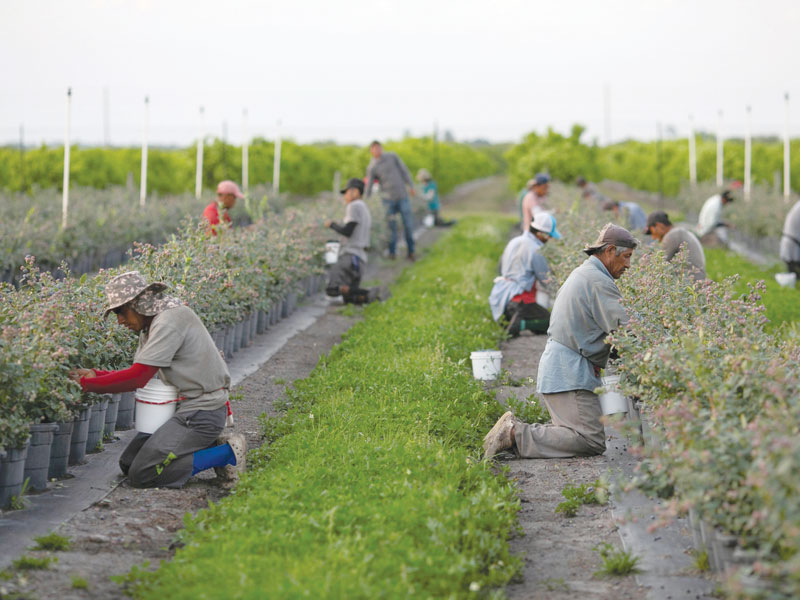
Mexican migrant workers harvest blueberries at a farm in Lake Wales, Florida. The vast majority of U.S. agricultural workers are foreign-born. (OSV News/Marco Bello/Reuters/U.S.)
Recently, a parent shared with me her feelings of anguish because her husband was detained. The mother also worried about their 2-year-old daughter. Initially when the mom would speak to her husband on the phone, the toddler expressed excitement and delight. However, the child has started to turn away upon hearing his voice, and has stopped talking.
During my morning commute, I reflect on the families and babies I am scheduled to see. The number of missed appointments concerns me. Parents are afraid they may be stopped on the road by immigration or local law enforcement officers. Infants and toddlers are not receiving their regular checkups or the medical attention they need.
Churches are encouraging their congregations to stay home rather than risk detainment. A communal culture based on convivencia (togetherness) with extended family and friends, that celebrates every passage of life and relies on ministers for encouraging words of hope and comfort, is being made to isolate and go into hiding.
Resilient, family-oriented, hardworking and faithful people face new and unreasonable challenges. Parents now hesitate to accompany their children to school. For young children, that absence can be unsettling; some worry that mom or dad might not be there when they go home. Parents are much less likely to attend school meetings, becoming less involved in their children’s education.
Of the people who had entered the States without the protection of programs like TPS, most would have begun the long process of seeking a legal means of remaining. That is no longer the case because of heavy interagency policing with the goal of expedited deportations. The fear and reality among the people is that if apprehended, they will not be permitted to follow due process.
Whatever our responses may be to complex immigration policy issues, they must include compassion. I’m reminded of what Jesus says in St. Matthew’s Gospel (25:31-46) when he told his friends that they visited him in prison and welcomed him when he was a stranger. His friends couldn’t remember doing any of these things. Jesus made it clear that when we perform these works of mercy for the least of our brothers and sisters, we do them for him.
When we respond to others with compassion, we love as he loves, and hearts are transformed. Policy is complicated, but it can be undertaken with compassion, dignity and respect, which from my perspective, are what we are missing.
The darkness of my morning commute always brings the light of a new day. Hope sustains me. Our acts of goodness and kindness toward each other will be the light that overcomes the darkness of this time.
Featured image: Heidy Sánchez, deported to Havana, Cuba, cries after talking to her daughter, a toddler, in Florida. Deportation protections have been ended for hundreds of thousands of legal immigrants from Cuba, Haiti, Nicaragua and Venezuela. (OSV News/Mario Fuentes/Reuters/Cuba)