“We come here to begin to relieve an ancient wrong. We wish especially to restore to this Earth its ancient joy. For while much of what we have done is beyond healing, there is a resilience throughout the land that only awaits its opportunity to flourish once again with something of its ancient splendor.” — Thomas Berry
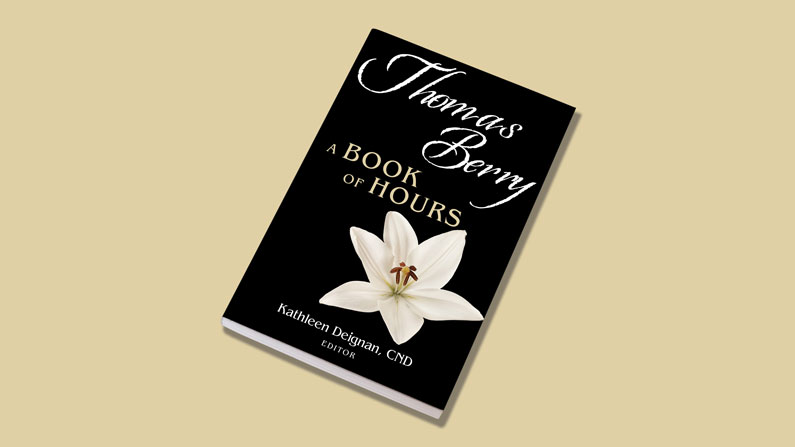
The work of Thomas Berry, a Passionist priest, ecological prophet and self-described “geologian,” is the focus of this “Book of Hours.” Editor Kathleen Deignan, a Sister of the Congregation of Notre Dame and the editor of previous “breviaries” drawn from Thomas Merton and Pierre Teilhard de Chardin, has arranged readings from Berry under themes divided into eight days. Each day includes prayers, hymns and readings for the four moments of the day: Dawn, Day, Dusk and Dark. The result is truly a book of hours, a guide to daily prayer and meditation drawn from Berry’s profound, faith-filled understanding of nature and our place in the earth community.
Berry, who died in 2009, became well-known for his work on what he called “the universe story,” the effort to set our own human story within the immensity of the vast and evolving universe. In his many books, including The Dream of the Earth, he outlined the principles of ecology and defined the “great work” that lies before us: to develop an “Ecozoic” consciousness capable of sustaining life on this planet. His work anticipated the principles of Pope Francis’ Laudato Si’ with its call for “ecological conversion” and a spirituality attuned to care for our common home. This Book of Hours could well serve as an invitation to incorporate that spirituality in our personal prayer and corporate worship.
The book begins with a meditation by Berry on a boyhood experience while standing in a meadow filled with lilies. That numinous moment, he said, provided orientation and meaning to his later life, an early intuition of the mystery of life and our relationship with nature. “Whatever preserves and enhances this meadow in the natural cycles of its transformation is good,” he concluded; “what is opposed to this meadow or negates it is not good.”
This lesson applied to many dimensions of life, including religion: “Religion too, it seems to me, takes its origin here in the deep mystery of this setting. The more a person thinks of the infinite number of interrelated activities taking place here the more mysterious it all becomes, the more meaning a person finds in the Maytime blooming of the lilies, the more awestruck a person might be in simply looking out over this little patch of meadowland.” This theme of interconnection of all created beings, and the challenge to allow this truth to shape our spirituality and our practice, permeates the texts gathered here.
Describing the motive for this work, Sister Kathleen writes: “Ours is an era of both evolutionary and revolutionary transmutations affecting every facet of terrestrial life. We cosmic pilgrims are making our way on a heroic journey in an ineffable, still-unfolding universe toward a destiny both unknown and unimaginable. For such a hazardous adventure we need guides of all sorts. Most especially, we need spiritual guides — sages and shamans, mystics and mentors — to shine forth and illuminate the way before us with their hard-won and divinely-inspired wisdom.”
Father Thomas Berry was such a guide. “May [his words] become a new vocabulary of Ecozoic prayer, as Thomas opens for you the doors to the ‘house of life’ shining forth at dawn, at day, at dusk, and at dark.”
Robert Ellsberg is the publisher of Maryknoll’s Orbis Books.