Maryknoll Lay Missioner Dee Dungy advocates for women refugees in East Africa.
Mahlet Tesfom is a 26-year-old Eritrean refugee who had fled to Ethiopia with her two children. Abandoned by her husband, she had to flee again when soldiers invaded their refugee camp. Raped and injured on the journey, she found her way with the children to a Jesuit Refugee Service (JRS) community center where they received help.
“Whenever I think of the situations that happened to me, I feel great shame,” Tesfom says. “But now I can pour out my experience to someone, and I am comforted by the compassion and the support that I receive. I have started to see a glimmer of hope.”
Maryknoll Lay Missioner Dee Dungy helps make possible such glimmers of hope.
Dungy has met many other women like Mahlet Tesfom at Kakuma, one of the world’s largest refugee camps. Kakuma, which is located in Kenya, hosts almost a quarter million refugees and asylum seekers from all around East Africa.
The road to Kakuma started for Dungy in Sunrise, Florida. Already active in her parish, St. Bernard’s, she enrolled in an intensive nine-month program called JustFaith. The program teaches participants “to address the root causes of injustice, while serving with love,” she says.
Dungy also belonged to a prayer group held regularly at the Trappist Holy Spirit monastery in Conyers, Georgia. There, sisters, brothers and laypeople came together once a month to pray, reflect on Scripture and share about their faith.
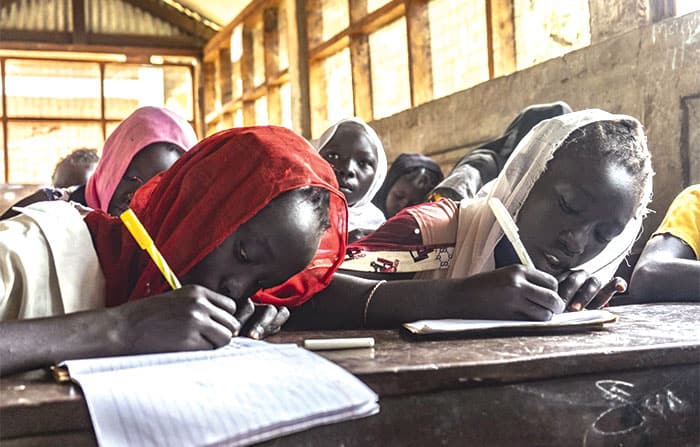
Girls in a refugee camp study in a JRS educational program. (Courtesy of Jesuit Refugee Service/South Sudan)
“A sister gave me a copy of Maryknoll magazine, saying, ‘Take this home, and bring it back next month,’” she recalls. “At the next meeting, she asked me, ‘So what did you think?’ I just said, ‘Oh, there are a lot of fascinating articles,’” Dungy says.
“The sister replied, ‘Is that all?’” continues Dungy. “She pointed to an announcement about a Maryknoll discernment retreat called ‘Come and See.’ I said, ‘Oh my goodness — I do want to come and see!’”
Dungy went to the retreat, where, she says, “I fell in love with Maryknoll.” She applied to the Maryknoll Lay Missioners immediately afterward and joined in 2011.
With a bachelor’s degree in market research from Indiana University Bloomington, studies in graphic design at Purdue University and a property and casualty insurance license, Dungy had a successful career. Yet, she says, “I had no hesitation about quitting my job. Maryknoll launched me on really living the Gospel in a much deeper way.”
Her first assignment was to Cambodia. There, among other ministries, she worked with abandoned elderly people and internally displaced youth and young adults at the Maryknoll Anlong Kngan Resettlement and Social Development Center. The center served an informal settlement on the outskirts of Phnom Penh where thousands of poor people lived in makeshift housing after a fire burned their homes.
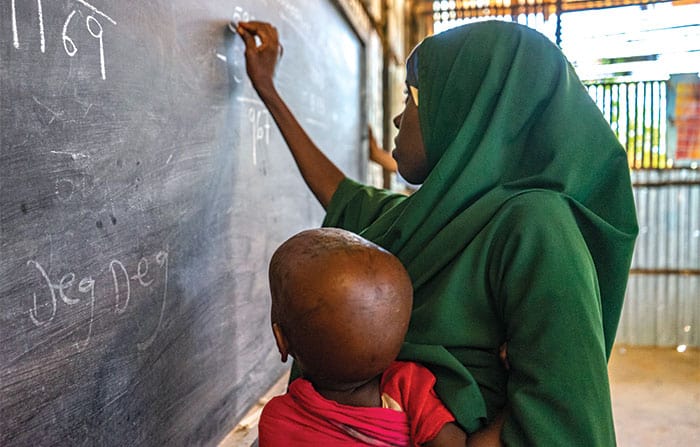
A woman in a refugee camp takes part in a JRS literacy program for adults. (Courtesy of Jesuit Refugee Service/Ethiopia)
After six years in Cambodia, Dungy moved to Nairobi, Kenya, where she now works as a regional advocacy coordinator with Jesuit Refugee Service Eastern Africa.
“We advocate for refugees and internally displaced persons to ensure that they are treated with dignity,” Dungy says. She adds that it is important to put them “at the center of policies, programs and laws” and explains, “We lobby governments and institutions for better and just responses to refugees and situations of forced displacement.”
Jesuit Refugee Service works throughout the region, in Kenya, Ethiopia, Uganda, South Sudan, Burundi and Tanzania. In 2021, JRS Eastern Africa served a total of 118,937 refugees. The agency employs approximately 300 staff and more than 650 additional “incentive staff:” the refugees and internally displaced people who work in different roles for JRS.
A main focus for Dungy’s work is capacity building for JRS’s country directors, project managers and field workers. She gives training workshops to help them to reach their program goals in addressing the various concerns of refugees at the camps’ grassroots level.
Among other topics, Dungy’s training workshops cover refugee laws; human rights; education; discrimination; the United Nations sustainable development goals; the link between ecology, migration and displacement; internal displacement; human trafficking; and gender equality.
Much of her work promotes the rights of women and girls. “We work toward including women and girls in all decision-making and leadership positions,” she says. “In the ‘normal’ course of events and in many of the cultures that the refugees come from, their perspectives and contributions would not be considered or would be ignored or dismissed,” she adds.
One of the effects of the COVID-19 pandemic was an increase in rapes of girls and resulting pregnancies. In some parts of East Africa, pregnant girls are still not allowed to continue their education in school. JRS advocates for their rights.
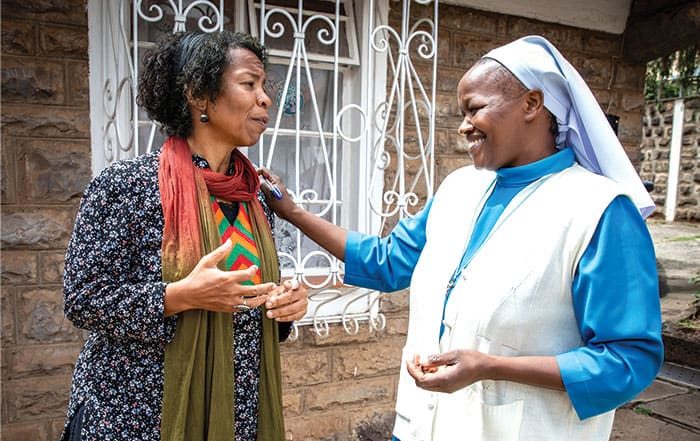
Dee Dungy, who joined the Maryknoll Lay Missioners in 2011, talks with Emmanuel Sister Beth Waithera (right), who works in a JRS livelihood program. (Jerry Fleury/Kenya)
“We know that the education of girls and women is crucial,” Dungy says. “I urge everyone to make sure that their girls are educated because that is really the key to everything. Too many adolescent and teen girls are still taken out of school as they physically mature and their families look to get them married.”
Dungy says she sees hope in the greater involvement of women refugees taking leadership responsibilities. “Women are showing up now, and they are asking the right questions,” she says.
Although “there is still a long way to go,” she says, she is encouraged by the increasing numbers of men who are receptive to women’s empowerment. After workshops, men sometimes come up to her and say, “Wow. We really need this.”
These small steps are welcome signs of change. Many of the stories of refugee women are heartbreaking, she says. So many of them — like Mahlet Tesfom — experience great violence and trauma before, during and after fleeing from home.
Dungy recalls a meeting at the Kakuma Refugee Camp led by women in a community-based safe space. She listened as the women spoke about their journeys to Kakuma. “It deeply unsettled me,” Dungy says. “They told harrowing stories about their escapes at night, as they fled tribal or political unrest. I cringed when many said they only had time to grab their children and had to leave their emotions behind.”
Some of the women said they found out about impending raids from their sons who were child soldier recruits.
“One by one,” Dungy says, “the women shared the awful choices they faced: the choice to stay with their land, their source of food and income; to flee and risk being caught and exploited by captors; or the hope of reaching Kakuma camp unscathed, giving their children a chance to survive.”
Even though this work can be deeply disturbing, Dungy says that she has found “true happiness” as a lay missioner. She shares, “The life-changing encounters that God has given me through serving others have been a great grace in my life.”
Featured image: Based in Nairobi, Maryknoll Lay Missioner Dee Dungy serves as regional advocacy coordinator for Jesuit Refugee Service Eastern Africa. (Jerry Fleury/Kenya)